What Family (Dynasty) Ruled the Franks Until the Late 900s?
| Kingdom of the Franks Regnum Francorum (Latin) | |||||||||||||||||
|---|---|---|---|---|---|---|---|---|---|---|---|---|---|---|---|---|---|
| 481–843 | |||||||||||||||||
 Diachronic map of the Frankish kingdom at its greatest extent | |||||||||||||||||
| Capital |
47°14′24″N 6°1′12″Eastward / 47.24000°North 6.02000°E / 47.24000; half dozen.02000 Coordinates: 47°14′24″Due north six°1′12″Due east / 47.24000°N 6.02000°Eastward / 47.24000; vi.02000 | ||||||||||||||||
| Common languages | Frankish, Latin, Vulgar Latin (Gallo-Roman), Gaulish | ||||||||||||||||
| Faith | Originally Frankish paganism, most of the Frankish elite shifted to Chalcedonian Christianity by 750 Ad[one] | ||||||||||||||||
| Government | Monarchy | ||||||||||||||||
| Rex of the Franks | |||||||||||||||||
| • 481–511 | Clovis I | ||||||||||||||||
| • 613–629 | Chlothar II | ||||||||||||||||
| • 629–639 | Dagobert I | ||||||||||||||||
| • 751–768 | Pepin the Brusque | ||||||||||||||||
| • 768–814 | Charlemagne | ||||||||||||||||
| • 814–840 | Louis the Pious | ||||||||||||||||
| Historical era | Centre Ages | ||||||||||||||||
| • Established | 481 | ||||||||||||||||
| • Clovis I crowned first Male monarch of the Franks | 496 | ||||||||||||||||
| • Charlemagne crowned Holy Roman Emperor | 25 Dec 800 | ||||||||||||||||
| • Treaty of Verdun | 843 | ||||||||||||||||
| Area | |||||||||||||||||
| 814 est.[two] | one,200,000 kmtwo (460,000 sq mi) | ||||||||||||||||
| Currency | Denier | ||||||||||||||||
| |||||||||||||||||


Francia, as well chosen the Kingdom of the Franks (Latin: Regnum Francorum), Frankish Kingdom, Frankland or Frankish Empire, was the largest post-Roman barbarian kingdom in Western Europe. Information technology was ruled past the Franks during Late Antiquity and the Early Middle Ages. After the Treaty of Verdun in 843, West Francia became the predecessor of France, and E Francia became that of Deutschland. Francia was amid the final surviving Germanic kingdoms from the Migration Menstruum era before its segmentation in 843.
The cadre Frankish territories inside the old Western Roman Empire were shut to the Rhine and Maas rivers in the north. Later on a flow where small-scale kingdoms interacted with the remaining Gallo-Roman institutions to their due south, a unmarried kingdom uniting them was founded by Clovis I who was crowned Male monarch of the Franks in 496. His dynasty, the Merovingian dynasty, was eventually replaced by the Carolingian dynasty. Nether the nearly continuous campaigns of Pepin of Herstal, Charles Martel, Pepin the Curt, Charlemagne, and Louis the Pious—father, son, grandson, peachy-grandson and great-great-grandson—the greatest expansion of the Frankish empire was secured past the early 9th century, and was by this point dubbed the Carolingian Empire.
During the Merovingian and Carolingian dynasties the Frankish realm was one large kingdom polity subdivided into several smaller kingdoms, oftentimes finer contained. The geography and number of subkingdoms varied over time, but a basic dissever betwixt eastern and western domains persisted. The eastern kingdom was initially chosen Austrasia, centred on the Rhine and Meuse, and expanding eastwards into central Europe. Following the Treaty of Verdun in 843, the Frankish Realm was divided into 3 separate kingdoms: West Francia, Middle Francia and East Francia. In 870, Middle Francia was partitioned once more, with nearly of its territory being divided among West and East Francia, which would hence form the nuclei of the future Kingdom of France and the Holy Roman Empire respectively, with Westward Francia (France) eventually retaining the choronym.
History [edit]

Origins [edit]
The term "Franks" emerged in the tertiary century Advertizing, roofing Germanic tribes who settled on the northern Rhine borderland of the Roman Empire, including the Bructeri, Ampsivarii, Chamavi, Chattuarii and Salians. While all of them had a tradition of participating in the Roman military, the Salians were allowed to settle inside the Roman Empire. In 358, having already been living in the civitas of Batavia for some time, Emperor Julian defeated the Chamavi and Salians,[3] allowing the latter to settle further away from the border, in Toxandria.[iv]
Some of the early Frankish leaders, such as Flavius Bauto and Arbogast, were committed to the crusade of the Romans, just other Frankish rulers, such as Mallobaudes, were agile on Roman soil for other reasons. Later on the fall of Arbogastes, his son Arigius succeeded in establishing a hereditary countship at Trier and after the fall of the usurper Constantine Iii some Franks supported the usurper Jovinus (411). Jovinus was dead by 413, but the Romans found it increasingly difficult to manage the Franks within their borders.
The Frankish king Theudemer was executed by the sword, in c. 422.
Around 428, the king Chlodio, whose kingdom may have been in the civitas Tungrorum (with its capital in Tongeren), launched an assault on Roman territory and extended his realm as far every bit Camaracum (Cambrai) and the Somme. Though Sidonius Apollinaris relates that Flavius Aetius defeated a wedding ceremony party of his people (c. 431), this period marks the beginning of a situation that would endure for many centuries: the Germanic Franks ruled over an increasing number of Gallo-Roman subjects.
The Merovingians, reputed to exist relatives of Chlodio, arose from inside the Gallo-Roman military machine, with Childeric and his son Clovis being called "Male monarch of the Franks" in the Gallo-Roman military, even before having any Frankish territorial kingdom. One time Clovis defeated his Roman competitor for power in northern Gaul, Syagrius, he turned to the kings of the Franks to the n and east, as well as other post-Roman kingdoms already existing in Gaul: Visigoths, Burgundians, and Alemanni.
The original core territory of the Frankish kingdom later came to exist known as Austrasia (the "eastern lands"), while the large Romanised Frankish kingdom in northern Gaul came to be known as Neustria.
Merovingian rising and decline, 481–687 [edit]
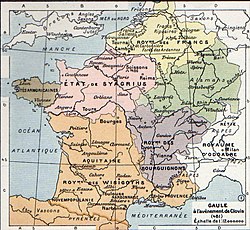
Chlodio's successors are obscure figures, but what can exist certain is that Childeric I, possibly his grandson, ruled a Salian kingdom from Tournai every bit a foederatus of the Romans. Childeric is importantly important to history for bequeathing the Franks to his son Clovis, who began an effort to extend his potency over the other Frankish tribes and to expand their territorium due south and due west into Gaul. Clovis converted to Christianity and put himself on good terms with the powerful Church building and with his Gallo-Roman subjects.
In a 30-year reign (481–511) Clovis defeated the Roman general Syagrius and conquered the Kingdom of Soissons, defeated the Alemanni (Battle of Tolbiac, 496) and established Frankish hegemony over them. Clovis defeated the Visigoths (Battle of Vouillé, 507) and conquered all of their territory north of the Pyrenees save Septimania, and conquered the Bretons (according to Gregory of Tours) and made them vassals of Francia. He conquered well-nigh or all of the neighbouring Frankish tribes along the Rhine and incorporated them into his kingdom.
He as well incorporated the diverse Roman military settlements (laeti) scattered over Gaul: the Saxons of Bessin, the Britons and the Alans of Armorica and Loire valley or the Taifals of Poitou to proper name a few prominent ones. By the finish of his life, Clovis ruled all of Gaul salve the Gothic province of Septimania and the Burgundian kingdom in the southeast.
The Merovingians were a hereditary monarchy. The Frankish kings adhered to the practice of partible inheritance: dividing their lands amidst their sons. Even when multiple Merovingian kings ruled, the kingdom—non unlike the belatedly Roman Empire—was conceived of every bit a single realm ruled collectively by several kings and the turn of events could effect in the reunification of the whole realm under a single king. The Merovingian kings ruled by divine correct and their kingship was symbolised daily by their long hair and initially by their acclaim, which was carried out past raising the king on a shield in accord with the aboriginal Germanic practice of electing a war-leader at an assembly of the warriors.
Clovis's sons [edit]
At the death of Clovis, his kingdom was divided territorially past his four adult sons in such a way that each son was granted a comparable portion of fiscal state, which was probably land in one case function of the Roman fisc, now seized past the Frankish authorities.

The division of Francia on Clovis'due south death (511). The kingdoms were not geographic unities because they were formed in an attempt to create equal-sized fiscs. The discrepancy in size reveals the concentration of Roman fiscal lands.
Clovis'southward sons fabricated their capitals near the Frankish heartland in northeastern Gaul. Theuderic I fabricated his capital at Reims, Chlodomer at Orléans, Childebert I at Paris, and Chlothar I at Soissons. During their reigns, the Thuringii (532), Burgundes (534), and Saxons and Frisians (c. 560) were incorporated into the Frankish kingdom. The outlying trans-Rhenish tribes were loosely fastened to Frankish sovereignty, and though they could exist forced to contribute to Frankish military machine efforts, in times of weak kings they were uncontrollable and liable to attempt independence. The Romanised Burgundian kingdom, nonetheless, was preserved in its territoriality by the Franks and converted into ane of their primary divisions, incorporating the central Gallic heartland of Chlodomer'due south realm with its capital at Orléans.
The fraternal kings showed only intermittent signs of friendship and were often in rivalry. On the early death of Chlodomer, his brother Chlothar had his young sons murdered in guild to take a share of his kingdom, which was, in accordance with custom, divided betwixt the surviving brothers. Theuderic died in 534, but his developed son Theudebert I was capable of defending his inheritance, which formed the largest of the Frankish subkingdoms and the kernel of the afterward kingdom of Austrasia.
Theudebert was the first Frankish rex to formally sever his ties to the Byzantine Empire by striking gold coins with his own paradigm on them and calling himself magnus rex (bully male monarch) because of his supposed suzerainty over peoples as far away every bit Pannonia. Theudebert interfered in the Gothic State of war on the side of the Gepids and Lombards confronting the Ostrogoths, receiving the provinces of Raetia, Noricum, and function of Veneto.
Chlothar [edit]
His son and successor, Theudebald, was unable to retain them and on his expiry all of his vast kingdom passed to Chlothar, under whom, with the death of Childebert in 558, the entire Frankish realm was reunited under the rule of one male monarch.
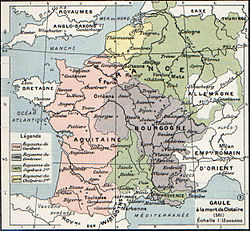
The division of Gaul on Chlothar I'southward death (561). Though more geographically unified realms were created out of the 2d fourfold division of Francia, the circuitous division of Provence created many problems for the rulers of Burgundy and Austrasia.
In 561 Chlothar died and his realm was divided, in a replay of the events of l years prior, betwixt his four sons, with the chief cities remaining the same. The eldest son, Charibert I, inherited the kingdom with its capital at Paris and ruled all of western Gaul. The 2d eldest, Guntram, inherited the erstwhile kingdom of the Burgundians, augmented by the lands of central French republic around the old capital of Orléans, which became his primary urban center, and most of Provence.
The rest of Provence, the Auvergne, and eastern Aquitaine were assigned to the 3rd son, Sigebert I, who also inherited Austrasia with its chief cities of Reims and Metz. The smallest kingdom was that of Soissons, which went to the youngest son, Chilperic I. The kingdom Chilperic ruled at his death (584) became the nucleus of afterwards Neustria.
This second fourfold division was quickly ruined by fratricidal wars, waged largely over the murder of Galswintha, the wife of Chilperic, allegedly by his mistress (and second married woman) Fredegund. Galswintha's sister, the wife of Sigebert, Brunhilda, incited her husband to war and the conflict between the two queens continued to plague relations until the next century. Guntram sought to keep the peace, though he as well attempted twice (585 and 589) to conquer Septimania from the Goths, but was defeated both times.
All the surviving brothers benefited at the death of Charibert, merely Chilperic was also able to extend his say-so during the menses of state of war by bringing the Bretons to heel again. After his expiry, Guntram had to again force the Bretons to submit. In 587, the Treaty of Andelot—the text of which explicitly refers to the entire Frankish realm every bit Francia—betwixt Brunhilda and Guntram secured his protection of her young son Childebert Two, who had succeeded the assassinated Sigebert (575). Together the territory of Guntram and Childebert was well over thrice as large as the small realm of Chilperic's successor, Chlothar Two. During this period Francia took on the tripartite character information technology was to have throughout the rest of its history, being equanimous of Neustria, Austrasia, and Burgundy.

Francia split up into Neustria, Austrasia, and Burgundy [edit]
When Guntram died in 592, Burgundy went to Childebert in its entirety, just he died in 595. His 2 sons divided the kingdom, with the elder Theudebert II taking Austrasia plus Childebert'southward portion of Aquitaine, while his younger brother Theuderic 2 inherited Burgundy and Guntram'southward Aquitaine. United, the brothers sought to remove their father'southward cousin Chlothar II from power and they did succeed in conquering nearly of his kingdom, reducing him to just a few cities, but they failed to capture him.
In 599 they routed his forces at Dormelles and seized the Dentelin, simply they so fell foul of each other and the remainder of their time on the thrones was spent in infighting, oft incited past their grandmother Brunhilda, who, angered over her expulsion from Theudebert's court, convinced Theuderic to unseat him and kill him. In 612 he did and the whole realm of his father Childebert was one time over again ruled past ane man. This was brusk-lived, however, as he died on the eve of preparing an expedition against Chlothar in 613, leaving a immature son named Sigebert II.
During their reigns, Theudebert and Theuderic campaigned successfully in Gascony, where they had established the Duchy of Gascony and brought the Basques to submission (602). This original Gascon conquest included lands south of the Pyrenees, namely Biscay and Gipuzkoa, just these were lost to the Visigoths in 612.
On the opposite stop of his realm, the Alemanni had defeated Theuderic in a rebellion and the Franks were losing their hold on the trans-Rhenish tribes. In 610 Theudebert had extorted the Duchy of Alsace from Theuderic, beginning a long period of disharmonize over which kingdom was to have the region of Alsace, Burgundy or Austrasia, which was simply terminated in the belatedly seventh century.
During the cursory minority of Sigebert 2, the part of the Mayor of the Palace, which had for sometime been visible in the kingdoms of the Franks, came to the fore in its internal politics, with a faction of nobles coalescing around the persons of Warnachar II, Rado, and Pepin of Landen, to give the kingdom over to Chlothar in order to remove Brunhilda, the immature king's regent, from power. Warnachar was himself already the mayor of the palace of Austrasia, while Rado and Pepin were to observe themselves rewarded with mayoral offices after Chlothar's insurrection succeeded and Brunhilda and the x-twelvemonth-old male monarch were killed.
Rule of Chlothar Two [edit]
Immediately after his victory, Chlothar Ii promulgated the Edict of Paris (614), which has more often than not been viewed as a concession to the nobility, though this view has come under recent criticism. The Edict primarily sought to guarantee justice and end corruption in government, only it also entrenched the regional differences between the three kingdoms of Francia and probably granted the nobles more control over judicial appointments.
By 623 the Austrasians had begun to clamour for a king of their own, since Chlothar was so often absent from the kingdom and, because of his upbringing and previous rule in the Seine basin, was more than or less an outsider at that place. Chlothar thus granted that his son Dagobert I would be their king and he was duly acclaimed by the Austrasian warriors in the traditional manner. Nonetheless, though Dagobert exercised true authority in his realm, Chlothar maintained ultimate control over the whole Frankish kingdom.
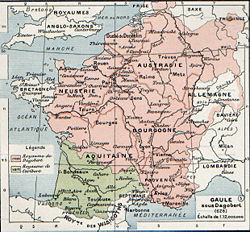
During the joint reign of Chlothar and Dagobert, who have been called "the last ruling Merovingians", the Saxons, who had been loosely attached to Francia since the late 550s, rebelled under Berthoald, Knuckles of Saxony, and were defeated and reincorporated into the kingdom past the articulation action of begetter and son. When Chlothar died in 628, Dagobert, in accord with his father's wishes, granted a subkingdom to his younger blood brother Charibert II. This subkingdom, commonly called Aquitaine, was a new cosmos.
Dagobert I [edit]

Dagobert, in his dealings with the Saxons, Alemans, and Thuringii, equally well equally the Slavs beyond the borders of Francia, upon whom he tried to strength tribute just who instead defeated him under their male monarch Samo at the Battle of Wogastisburg in 631, fabricated all the far eastern peoples subject to the courtroom of Neustria and not of Austrasia. This, get-go and foremost, incited the Austrasians to request a king of their own from the royal household.
The subkingdom of Aquitaine corresponded to the southern half of the old Roman province of Aquitania and its capital was at Toulouse. The other cities of his kingdom were Cahors, Agen, Périgueux, Bordeaux, and Saintes; the duchy of Vasconia was also part of his allotment. Charibert campaigned successfully against the Basques, simply afterward his decease they revolted again (632). At the same time the Bretons rose up against Frankish suzerainty. The Breton leader Judicael relented and made peace with the Franks and paid tribute later Dagobert threatened to lead an regular army confronting him (635). That same yr Dagobert sent an army to subdue the Basques, which it did.
Meanwhile, Dagobert had Charibert'southward baby successor Chilperic assassinated and reunited the unabridged Frankish realm again (632), though he was forced by the strong Austrasian aristocracy to grant his own son Sigebert Iii to them every bit a subking in 633. This act was precipitated largely by the Austrasians desire to exist self-governing at a fourth dimension when Neustrians dominated at the royal courtroom. Chlothar had been the male monarch at Paris for decades before becoming the king at Metz too and the Merovingian monarchy was e'er after him to be a Neustrian monarchy get-go and foremost.
Indeed, it is in the 640s that "Neustria" first appears in writing, its late appearance relative to "Austrasia" probably due to the fact that Neustrians (who formed the majority of the authors of the fourth dimension) called their region simply "Francia". Burgundia besides defined itself in opposition to Neustria at about this fourth dimension. However, it was the Austrasians, who had been seen as a distinct people within the realm since the fourth dimension of Gregory of Tours, who were to make the most strident moves for independence.
The immature Sigebert was dominated during his minority past the mayor, Grimoald the Elder, who convinced the childless king to adopt his own Merovingian-named son Childebert every bit his son and heir. After Dagobert's death in 639, the duke of Thuringia, Radulf, rebelled and tried to make himself king. He defeated Sigebert in what was a serious reversal for the ruling dynasty (640).
The king lost the support of many magnates while on campaign and the weakness of the monarchic institutions by that time are evident in his disability to effectively brand war without the back up of the magnates; in fact, he could not even provide his own bodyguard without the loyal aid of Grimoald and Adalgisel. He is often regarded as the showtime roi fainéant: "practise-zip king", non insofar as he "did nothing", but insofar as he achieved little.
Clovis II, Dagobert's successor in Neustria and Burgundy, which were thereafter attached yet ruled separately, was a modest for nigh the whole of his reign. He was dominated by his mother Nanthild and the mayor of the Neustrian palace, Erchinoald. Erchinoald'southward successor, Ebroin, dominated the kingdom for the side by side fifteen years of well-nigh-abiding civil war. On his death (656), Sigbert's son was shipped off to Ireland, while Grimoald's son Childebert reigned in Austrasia.
Ebroin eventually reunited the unabridged Frankish kingdom for Clovis's successor Chlothar III by killing Grimoald and removing Childebert in 661. Yet, the Austrasians demanded a king of their own over again and Chlothar installed his younger brother Childeric Ii. During Chlothar's reign, the Franks had fabricated an assail on northwestern Italian republic, but were driven off by Grimoald, King of the Lombards, near Rivoli.
Say-so of the mayors of the palace, 687–751 [edit]
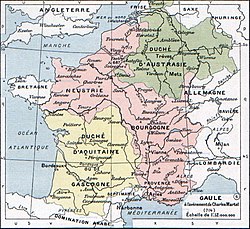
In 673, Chlothar Three died and some Neustrian and Burgundian magnates invited Childeric to become rex of the whole realm, merely he presently upset some Neustrian magnates and he was assassinated (675).
The reign of Theuderic III was to evidence the end of the Merovingian dynasty's power. Theuderic III succeeded his brother Chlothar Three in Neustria in 673, but Childeric II of Austrasia displaced him soon thereafter—until he died in 675, and Theuderic Three retook his throne. When Dagobert II died in 679, Theuderic received Austrasia as well and became king of the whole Frankish realm. Thoroughly Neustrian in outlook, he allied with his mayor Berchar and made state of war on the Austrasian who had installed Dagobert Ii, Sigebert III'south son, in their kingdom (briefly in opposition to Clovis III).
In 687 he was defeated by Pepin of Herstal, the Arnulfing mayor of Austrasia and the real power in that kingdom, at the Battle of Tertry and was forced to accept Pepin as sole mayor and dux et princeps Francorum: "Duke and Prince of the Franks", a title which signifies, to the writer of the Liber Historiae Francorum, the beginning of Pepin's "reign". Thereafter the Merovingian monarchs showed only sporadically, in our surviving records, any activities of a non-symbolic and self-willed nature.
During the period of defoliation in the 670s and 680s, attempts had been made to re-assert Frankish suzerainty over the Frisians, but to no avail. In 689, however, Pepin launched a campaign of conquest in Western Frisia (Frisia Citerior) and defeated the Frisian rex Radbod near Dorestad, an important trading middle. All the land betwixt the Scheldt and the Vlie was incorporated into Francia.
Then, circa 690, Pepin attacked central Frisia and took Utrecht. In 695 Pepin could even sponsor the foundation of the Archdiocese of Utrecht and the commencement of the conversion of the Frisians nether Willibrord. However, Eastern Frisia (Frisia Ulterior) remained outside of Frankish suzerainty.
Having achieved groovy successes against the Frisians, Pepin turned towards the Alemanni. In 709 he launched a war against Willehari, knuckles of the Ortenau, probably in an effort to strength the succession of the young sons of the deceased Gotfrid on the ducal throne. This outside interference led to another war in 712 and the Alemanni were, for the fourth dimension being, restored to the Frankish fold.
Even so, in southern Gaul, which was not under Arnulfing influence, the regions were pulling away from the royal court nether leaders such as Savaric of Auxerre, Antenor of Provence, and Odo of Aquitaine. The reigns of Clovis Iv and Childebert Iii from 691 until 711 have all the hallmarks of those of rois fainéants, though Childebert is founding making royal judgements against the interests of his supposed masters, the Arnulfings.
Death of Pepin [edit]
When Pepin died in 714, withal, the Frankish realm plunged into civil war and the dukes of the outlying provinces became de facto independent. Pepin's appointed successor, Theudoald, under his widow, Plectrude, initially opposed an attempt past the king, Dagobert III, to engage Ragenfrid as mayor of the palace in all the realms, but soon there was a tertiary candidate for the mayoralty of Austrasia in Pepin's illegitimate adult son, Charles Martel.
Later the defeat of Plectrude and Theudoald by the rex (now Chilperic II) and Ragenfrid, Charles briefly raised a king of his ain, Chlothar IV, in opposition to Chilperic. Finally, at a battle well-nigh Soisson, Charles definitively defeated his rivals and forced them into hiding, somewhen accepting the king back on the condition that he receive his father's positions (718). There were no more active Merovingian kings after that point and Charles and his Carolingian heirs ruled the Franks.
Afterwards 718 Charles Martel embarked on a series of wars intended to strengthen the Franks' hegemony in western Europe. In 718 he defeated the rebellious Saxons, in 719 he overran Western Frisia, in 723 he suppressed the Saxons once more, and in 724 he defeated Ragenfrid and the rebellious Neustrians, ending the civil war phase of his rule. In 720, when Chilperic II died, he had appointed Theuderic Four king, but this last was a mere boob of his. In 724 he forced his choice of Hugbert for the ducal succession upon the Bavarians and forced the Alemanni to assist him in his campaigns in Bavaria (725 and 726), where laws were promulgated in Theuderic'south name. In 730 Alemannia had to be subjugated by the sword and its duke, Lantfrid, was killed. In 734 Charles fought confronting Eastern Frisia and finally subdued it.
Umayyad invasion [edit]
In the 730s the Umayyad conquerors of Spain, who had also subjugated Septimania, began advancing northwards into primal Francia and the Loire valley. It was at this time (circa 736) that Maurontus, the dux of Provence, chosen in the Umayyads to aid him in resisting the expanding influence of the Carolingians. However, Charles invaded the Rhône Valley with his brother Childebrand and a Lombard ground forces and devastated the region. Information technology was considering of the alliance against the Arabs that Charles was unable to support Pope Gregory III confronting the Lombards.
In 732 or 737—modern scholars take debated over the date—Charles marched against an Arab-berber army betwixt Poitiers and Tours and defeated information technology in a watershed battle that turned back the tide of the Arab-berber advance north of the Pyrenees. Merely Charles's real interests lay in the northeast, primarily with the Saxons, from whom he had to extort the tribute which for centuries they had paid to the Merovingians.
Shortly earlier his death in October 741, Charles divided the realm equally if he were king between his 2 sons by his showtime married woman, marginalising his younger son Grifo, who did receive a pocket-size portion (information technology is unknown exactly what). Though there had been no king since Theuderic's death in 737, Charles's sons Pepin the Younger and Carloman were withal only mayors of the palaces. The Carolingians had assumed the regal status and exercise, though not the regal title, of the Merovingians. The segmentation of the kingdom gave Austrasia, Alemannia, and Thuringia to Carloman and Neustria, Provence, and Burgundy to Pepin. It is indicative of the de facto autonomy of the duchies of Aquitaine (under Hunoald) and Bavaria (under Odilo) that they were not included in the partitioning of the regnum.
After Charles Martel was buried, in the Abbey of Saint-Denis alongside the Merovingian kings, conflict immediately erupted betwixt Pepin and Carloman on one side and Grifo their younger brother on the other. Though Carloman captured and imprisoned Grifo, it may have been enmity between the elderberry brothers that caused Pepin to release Grifo while Carloman was on a pilgrimage to Rome. Perhaps in an effort to neutralise his brother's ambitions, Carloman initiated the appointment of a new king, Childeric Iii, drawn from a monastery, in 743. Others take suggested that perhaps the position of the ii brothers was weak or challenged, or perhaps there Carloman was only interim for a loyalist or legitimist party in the kingdom.
In 743 Pepin campaigned against Odilo and forced him to submit to Frankish suzerainty. Carloman too campaigned confronting the Saxons and the two together defeated a rebellion led past Hunoald at the head of the Basques and some other led past Alemanni, in which Liutfrid of Alsatia probably died, either fighting for or against the brothers. In 746, however, the Frankish armies were still, as Carloman was preparing to retire from politics and enter the monastery of Mount Soratte. Pepin's position was further stabilised and the path was laid for his supposition of the crown in 751.
Carolingian empire, 751–840 [edit]


Pepin reigned as an elected king. Although such elections happened infrequently, a full general rule in Germanic law stated that the king relied on the support of his leading men. These men reserved the right to choose a new "kingworthy" leader out of the ruling clan if they felt that the old i could non lead them in profitable battle. While in later on France the kingdom became hereditary, the kings of the later Holy Roman Empire proved unable to abolish the constituent tradition and continued as elected rulers until the empire'southward formal stop in 1806.
Pepin solidified his position in 754 by entering into an alliance with Pope Stephen Ii, who presented the rex of the Franks a copy of the forged "Donation of Constantine" at Paris and in a magnificent anniversary at Saint-Denis anointed the king and his family and declared him patricius Romanorum ("protector of the Romans"). The following year Pepin fulfilled his promise to the pope and retrieved the Exarchate of Ravenna, recently fallen to the Lombards, and returned information technology to the Papacy.
Pepin donated the re-conquered areas effectually Rome to the Pope, laying the foundation for the Papal States in the "Donation of Pepin" which he laid on the tomb of St Peter. The papacy had good cause to wait that the remade Frankish monarchy would provide a deferential power base (potestas) in the cosmos of a new world social club, centred on the Pope.
Upon Pepin'southward death in 768, his sons, Charles and Carloman, once over again divided the kingdom between themselves. Even so, Carloman withdrew to a monastery and died shortly thereafter, leaving sole rule to his brother, who would later on get known as Charlemagne or Charles the Groovy, a powerful, intelligent, and modestly literate figure who became a legend for the later history of both France and Deutschland. Charlemagne restored an equal balance between emperor and pope.
From 772 onwards, Charles conquered and eventually defeated the Saxons to incorporate their realm into the Frankish kingdom. This campaign expanded the practice of non-Roman Christian rulers undertaking the conversion of their neighbours by armed strength; Frankish Catholic missionaries, forth with others from Ireland and Anglo-Saxon England, had entered Saxon lands since the mid-8th century, resulting in increasing conflict with the Saxons, who resisted the missionary efforts and parallel military incursions.
Charles's main Saxon opponent, Widukind, accepted baptism in 785 every bit office of a peace agreement, only other Saxon leaders continued to fight. Upon his victory in 787 at Verden, Charles ordered the wholesale killing of thousands of pagan Saxon prisoners. After several more uprisings, the Saxons suffered definitive defeat in 804. This expanded the Frankish kingdom eastwards every bit far as the Elbe river, something the Roman empire had only attempted one time, and at which information technology failed in the Battle of the Teutoburg Woods (ix Advertizing). In order to more effectively Christianize the Saxons, Charles founded several bishoprics, amidst them Bremen, Münster, Paderborn, and Osnabrück.
At the same time (773–774), Charles conquered the Lombards and thus included northern Italy in his sphere of influence. He renewed the Vatican donation and the hope to the papacy of continued Frankish protection.
In 788, Tassilo, dux (duke) of Bavaria rebelled against Charles. Crushing the rebellion incorporated Bavaria into Charles's kingdom. This not only added to the royal fisc, just also drastically reduced the power and influence of the Agilolfings (Tassilo's family unit), another leading family among the Franks and potential rivals. Until 796, Charles continued to expand the kingdom fifty-fifty farther southeast, into today's Austria and parts of Croatia.
Charles thus created a realm that reached from the Pyrenees in the southwest (really, including an area in Northern Espana (Marca Hispanica) after 795) over virtually all of today'due south France (except Brittany, which the Franks never conquered) eastwards to nigh of today's Germany, including northern Italy and today's Austria. In the hierarchy of the church, bishops and abbots looked to the patronage of the king's palace, where the sources of patronage and security lay. Charles had fully emerged as the leader of Western Christendom, and his patronage of monastic centres of learning gave rising to the "Carolingian Renaissance" of literate civilisation. Charles likewise created a large palace at Aachen, a series of roads, and a canal.
On Christmas Day, 800, Pope Leo III crowned Charles as "Emperor of the Romans" in Rome in a ceremony presented as a surprise (Charlemagne did not wish to be indebted to the bishop of Rome), a further papal move in the series of symbolic gestures that had been defining the mutual roles of papal auctoritas and majestic potestas. Though Charlemagne preferred the title "Emperor, king of the Franks and Lombards", the anniversary formally acknowledged the ruler of the Franks as the Roman Emperor, triggering disputes with the Byzantine Empire, which had maintained the championship since the sectionalisation of the Roman Empire into East and West. The pope's correct to proclaim successors was based on the Donation of Constantine, a forged Roman imperial decree. Afterwards an initial protestation at the usurpation, the Byzantine Emperor Michael I Rhangabes acknowledged in 812 Charlemagne as co-emperor, according to some. According to others, Michael I reopened negotiations with the Franks in 812 and recognized Charlemagne equally basileus (emperor), but non as emperor of the Romans. The coronation gave permanent legitimacy to Carolingian primacy among the Franks. The Ottonians later resurrected this connection in 962.
Upon Charlemagne's death on 28 Jan 814 in Aachen, he was buried in his ain Palace Chapel at Aachen.
Divided empire, after 840 [edit]

Charlemagne had several sons, but only ane survived him. This son, Louis the Pious, followed his father as the ruler of a united empire. Simply sole inheritance remained a matter of chance, rather than intent. When Louis died in 840, the Carolingians adhered to the custom of partible inheritance, and after a brief civil war between the three sons, they made an understanding in 843, the Treaty of Verdun, which divided the empire in three:
- Louis's eldest surviving son Lothair I became Emperor in name merely de facto only the ruler of the Eye Frankish Kingdom, or Middle Francia, known as King of the Key or Middle Franks. His three sons in plough divided this kingdom between them into Lotharingia (centered on Lorraine), Burgundy, and (Northern) Italy Lombardy. These areas with different cultures, peoples and traditions would later vanish as split kingdoms, which would eventually get Belgium, the netherlands, Grand duchy of luxembourg, Lorraine, Switzerland, Lombardy and the various departments of France along the Rhône drainage bowl and Jura massif.
- Louis'south second son, Louis the German, became King of the Eastward Frankish Kingdom or East Francia. This area formed the kernel of the subsequently Holy Roman Empire by way of the Kingdom of Deutschland enlarged with some additional territories from Lothair's Eye Frankish Realm: much of these territories eventually evolved into modern Austria, Switzerland and Germany. For a list of successors, see the List of German language monarchs.
- His 3rd son Charles the Bald became Male monarch of the Due west Franks, of the Due west Frankish Kingdom or West Francia. This expanse, most of today'south southern and western France, became the foundation for the later France under the Business firm of Capet. For his successors, see the Listing of French monarchs.
Afterwards, at the Treaty of Mersen (870) the partitions were recast, to the detriment of Lotharingia. On 12 December 884, Charles the Fat (son of Louis the High german) reunited well-nigh of the Carolingian Empire, aside from Burgundy. In belatedly 887, his nephew Arnulf of Carinthia revolted and assumed the championship as Rex of the Due east Franks. Charles retired and soon died on thirteen January 888.
Odo, Count of Paris was called to rule in the west, and was crowned the next calendar month. At this point, West Francia was composed of Neustria in the west and in the east by Francia proper, the region between the Meuse and the Seine. The Carolingians were restored ten years later in West Francia, and ruled until 987, when the last Frankish King, Louis V, died.
Westward Francia was the country under the command of Charles the Bald. It is the forerunner of mod France. It was divided into the post-obit neat fiefs: Aquitaine, Brittany, Burgundy, Catalonia, Flanders, Gascony, Gothia, the Île-de-France, and Toulouse. Later 987, the kingdom came to be known equally France, considering the new ruling dynasty (the Capetians) were originally dukes of the Île-de-France.
Middle Francia was the territory ruled by Lothair I, wedged between Eastward and Westward Francia. The kingdom, which included the Kingdom of Italy, Burgundy, the Provence, and the w of Austrasia, was an unnatural creation of the Treaty of Verdun, with no historical or ethnic identity. The kingdom was divide on the death of Lothair II in 869 into those of Lotharingia, Provence (with Burgundy divided between it and Lotharingia), and north Italia.
Eastward Francia was the state of Louis the German. It was divided into 4 duchies: Swabia (Alamannia), Franconia, Saxony and Bavaria; to which after the death of Lothair II were added the eastern parts of Lotharingia. This division persisted until 1268, the finish of the Hohenstaufen dynasty. Otto I was crowned on ii February 962, marking the get-go of the Holy Roman Empire (translatio imperii). From the 10th century, Eastward Francia became also known as regnum Teutonicum ("Teutonic kingdom" or "Kingdom of Deutschland"), a term that became prevalent in Salian times. The title of Holy Roman Emperor was used from that time, beginning with Conrad 2.
Life in Francia [edit]
Police [edit]
The dissimilar Frankish tribes, such as the Salii, Ripuarii, and Chamavi, had different legal traditions, which were only subsequently codified, largely under Charlemagne. The Leges Salica, Ribuaria, and Chamavorum were Carolingian creations, their basis in earlier Frankish reality being hard for scholars to discern at the present distance. Under Charlemagne codifications were too made of the Saxon police and the Frisian constabulary.
It was also under Frankish hegemony that the other Germanic societies east of the Rhine began to formulate their tribal law, in such compilations as the Lex Alamannorum and Lex Bajuvariorum for the Alemanni and Bavarii respectively. Throughout the Frankish kingdoms there continued to be Gallo-Romans subject to Roman law and clergy bailiwick to catechism police. After the Frankish conquest of Septimania and Catalonia, those regions which had formerly been nether Gothic control continued to utilize the Visigothic law code.
During the early period Frankish police was preserved by the rachimburgs, officials trained to remember it and pass it on. The Merovingians adopted the capitulary as a tool for the promulgation and preservation of regal ordinances. Its usage was to continue nether the Carolingians and even the later on Spoletan emperors Guy and Lambert under a programme of renovation regni Francorum ("renewal of the Frankish kingdom").
The last Merovingian capitulary was ane of the most meaning: the edict of Paris, issued past Chlothar II in 614 in the presence of his magnates, had been likened to a Frankish Magna Carta entrenching the rights of the dignity, but in actuality it sought to remove corruption from the judiciary and protect local and regional interests. Even after the concluding Merovingian capitulary, kings of the dynasty continued to independently practise some legal powers. Childebert III even constitute cases against the powerful Arnulfings and became renowned among the people for his justness. Merely constabulary in Francia was to feel a renaissance under the Carolingians.
Among the legal reforms adopted by Charlemagne were the codifications of traditional law mentioned above. He also sought to place checks on the power of local and regional judiciaries by the method of appointing missi dominici in pairs to oversee specific regions for short periods of time. Usually missi were selected from outside their corresponding regions in club to prevent conflicts of involvement. A capitulary of 802 gives insight into their duties. They were to execute justice, enforce respect for the royal rights, control the assistants of the counts and dukes (and so still royal appointees), receive the oath of allegiance, and supervise the clergy.
Church [edit]
The Frankish Church building grew out of the Church in Gaul in the Merovingian menses, which was given a particularly Germanic development in a number of "Frankish synods" throughout the sixth and 7th centuries, and with the Carolingian Renaissance, the Frankish Church became a substantial influence of the medieval Western Church building.
In the 7th century, the territory of the Frankish realm was (re-)Christianized with the aid of Irish and Scottish missionaries. The result was the establishment of numerous monasteries, which would get the nucleus of Old High High german literacy in the Carolingian Empire. Columbanus was active in the Frankish Empire from 590, establishing monasteries until his death at Bobbio in 615. He arrived on the continent with twelve companions and founded Annegray, Luxeuil, and Fontaines in France and Bobbio in Italy. During the seventh century the disciples of Columbanus and other Scottish and Irish missionaries founded several monasteries or Schottenklöster in what are now France, Germany, Kingdom of belgium, and Switzerland. The Irish influence in these monasteries is reflected in the adoption of Insular style in volume product, visible in eighth-century works such equally the Gelasian Sacramentary. The Insular influence on the uncial script of the later Merovingian period eventually gave mode to the development of the Carolingian minuscule in the 9th century.
Society [edit]
Immediately after the autumn of Rome and through the Merovingian dynasty, trading towns were re-established in the ruins of ancient cities. These specialised in exchange of goods, craft and agronomics, and were mostly independent of aloof control.[5] Carolingian Francia saw royal sponsorship for the construction of monastic cities, built to showcase a revival of the architecture of ancient Rome.[6] Administration was conducted past bishops. The erstwhile Gallo-Roman aristocrats had survived in prestige and equally an institution by taking upwardly the episcopal offices, and they were now put in charge of fields such as justice, infrastructure, education and social services. Kings were legitimized by their links with the religious institutions. Episcopal elections became supervised past the kings, and royal confirmation helped to strengthen the bishops' authority as well.[7] In that location were improvements in agriculture, notably the adoption of a new heavy turn and the growing use of the iii-field system.
Currency [edit]
Byzantine coinage was in use in Francia before Theudebert I began minting his ain money at the outset of his reign. The solidus and triens were minted in Francia betwixt 534 and 679. The denarius (or denier) appeared later, in the proper name of Childeric 2 and various non-royals around 673–675. A Carolingian denarius replaced the Merovingian one, and the Frisian penning, in Gaul from 755 to the eleventh century.
The denarius subsequently appeared in Italian republic issued in the name of Carolingian monarchs after 794,[8] later past and so-called "native" kings in the tenth century, and later withal by the German Emperors from Otto I (962). Finally, denarii were issued in Rome in the names of pope and emperor from Leo Three and Charlemagne onwards to the late tenth century.[nine]
Encounter also [edit]
- List of modernistic countries inside the Frankish Empire
- List of Frankish kings
References [edit]
Citations [edit]
- ^ Lorenz, Sönke (2001). Missionierung, Krisen und Reformen: Die Christianisierung von der Spätantike bis in Karolingische Zeit . Dice Alemannen . Stuttgart: Theiss. pp. 441–446. ISBNthree-8062-1535-9.
- ^ Taagepera, Rein (1997). "Expansion and Wrinkle Patterns of Big Polities: Context for Russia". International Studies Quarterly. 41 (3): 475–504. doi:10.1111/0020-8833.00053. JSTOR 2600793.
- ^ Ammianus Marcellinus Res Gestae (late fourth century), XVII.8
- ^ Bijsterveld, Arnoud-January A.; Toorians, Lauran (29 June 2018). "Texandria revisited: In search of a territory lost in fourth dimension". Rural Riches & Royal Rags?: Studies on Medieval and Modern Archaeology, Presented to Frans Theuws. SPA-Uitgevers: 35 – via Academia.edu.
- ^ Joachim Henning (2007). Postal service-Roman Towns, Trade and Settlement in Europe and Byzantium: The heirs of the Roman West. Walter de Gruyter. p. 29. ISBN978-3110183566.
- ^ Hendrik W. Dey (2015). The Afterlife of the Roman Metropolis. Cambridge Academy Press. pp. 219–222. ISBN978-1107069183.
- ^ Kreiner, Jamie. "Virtually the Bishop: The Episcopal Entourage and the Economic system of Government in Mail service-Roman Gaul.", vol. 86, no. 2, Medieval Academy of America, 2011, pp. 321–60, http://www.jstor.org/stable/41105589.
- ^ "Charlemagne and the Carolingian coinages". Britanica . Retrieved five July 2021.
- ^ Spufford, Peter (1989) [1988]. "Appendix I". Money and its use in medieval Europe. Cambridge: Cambridge University Press. pp. 398, 400–402. ISBN978-0-521-30384-2.
Sources [edit]
- Primary sources
- Ammianus Marcellinus. Roman History. trans. by Roger Pearse. London: Bohn, 1862.
- Procopius. History of the Wars. trans. past H. B. Dewing.
- Fredegar. The Fourth Volume of the Relate of Fredegar with its Continuations. trans. by John Michael Wallace-Hadrill. Connecticut: Greenwood Press, 1960.
- Fredegar. Historia Epitomata. Woodruff, Jane Ellen. PhD Dissertation, University of Nebraska–Lincoln, 1987.
- Gregory of Tours. Historia Francorum.
- Gregory of Tours. The History of the Franks. trans. by Ernest Brehaut. 1916. Excerpts here
- Gregory of Tours. The History of the Franks. ii vol. trans. O. M. Dalton. Oxford: Clarendon Press, 1967.
- Bachrach, Bernard South. (trans.) Liber Historiae Francorum. 1973.
- Secondary sources
- Bachrach, Bernard S. Merovingian Armed services Organization, 481–751. Minneapolis: University of Minnesota Press, 1971. ISBN 0-8166-0621-8
- Collins, Roger. Early Medieval Europe 300–1000. London: MacMillan, 1991.
- Fouracre, Paul. "The Origins of the Nobility in Francia." Nobles and Nobility in Medieval Europe: Concepts, Origins, Transformations, ed. Anne J. Duggan. Woodbridge: The Boydell Press, 2000. ISBN 0-85115-769-6.
- Geary, Patrick J. Before France and Germany: the Creation and Transformation of the Merovingian World. New York: Oxford University Press, 1988. ISBN 0-nineteen-504458-4
- James, Edward. The Franks. (Peoples of Europe series) Basil Blackwell, 1988. ISBN 0-631-17936-4
- Lewis, Archibald R. "The Dukes in the Regnum Francorum, A.D. 550–751." Speculum, Vol. 51, No 3 (July 1976), pp 381–410.
- McKitterick, Rosamond. The Frankish Kingdoms under the Carolingians, 751–987. London: Longman, 1983. ISBN 0-582-49005-7.
- Murray, Archibald C. and Goffart, Walter A. After Rome's Fall: Narrators and Sources of Early Medieval History. 1999.
- Nixon, C. E. Five. and Rodgers, Barbara. In Praise of Later Roman Emperors. Berkeley, 1994.
- Laury Sarti, "Perceiving War and the War machine in Early on Christian Gaul (ca. 400–700 A.D.)" (= Brill's Series on the Early on Middle Ages, 22), Leiden/Boston 2013, ISBN 978-9004-25618-seven.
- Schutz, Herbert. The Germanic Realms in Pre-Carolingian Central Europe, 400–750. American Academy Studies, Series Ix: History, Vol. 196. New York: Peter Lang, 2000.
- Wallace-Hadrill, J. 1000. The Long-Haired Kings. London: Butler & tanner Ltd, 1962.
- Wallace-Hadrill, J. Grand. The Barbarian Due west. London: Hutchinson, 1970.
External links [edit]
- Tabular array. Capitals of the Frankish Kingdom co-ordinate to the years, in 509 – 800
Source: https://en.wikipedia.org/wiki/Francia
 Ruled the Franks Until the Late 900s?)
Post a Comment for "What Family (Dynasty) Ruled the Franks Until the Late 900s?"