Oath of Words Only Once Again
Chief Justice John Roberts administering the presidential oath of office to Joe Biden on Jan xx, 2021.
The oath of office of the president of the United States is the oath or affirmation that the president of the United States takes upon bold role. The wording of the oath is specified in Article 2, Section I, Clause eight, of the United States Constitution, and a new president must take it earlier exercising or carrying out whatever official powers or duties.
This clause is one of 3 oath or affirmation clauses in the Constitution, merely it is the only one that actually specifies the words that must be spoken. Article I, Department three requires Senators, when sitting to try impeachments, to be "on Oath or Affirmation." Article Half-dozen, Clause 3, similarly requires the persons specified therein to "be jump past adjuration or affirmation, to support this Constitution." The presidential oath requires much more than that full general adjuration of allegiance and fidelity. This clause enjoins the new president to swear or affirm that he "will to the best of my ability, preserve, protect and defend the Constitution of the United States."[1]
Text [edit]
Before he enter on the Execution of his Part, he shall take the following Oath or Affidavit:— "I practice solemnly swear (or affirm) that I volition faithfully execute the Office of President of the United States, and will to the best of my Ability, preserve, protect and defend the Constitution of the United States." [2]
Swearing-in ceremony [edit]
A newly elected or re-elected president of the U.s. begins their 4-year term of office at noon on the twentieth mean solar day of January following the election, and, by tradition, takes the oath of role during an inauguration on that date; prior to 1937 the president's term of function began on March iv.[3] If January 20 falls on a Sunday, the president will be sworn in that day by taking the oath privately, only will then re-take the adjuration in a public ceremony the next mean solar day, on Jan 21.
Nine vice presidents take succeeded to the presidency upon the death or resignation of the president. In these situations the adjuration of function was administered to the new president equally quickly every bit possible, as doing and so immune the presidency to continue uninterrupted.[4]
Administration of the oath [edit]
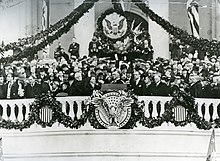
While the Constitution does not mandate that anyone in particular should administer the presidential oath of office, it has been administered by the chief justice beginning with John Adams, except post-obit the death of a sitting president. George Washington was sworn into office during his starting time inauguration, on April 30, 1789, by Chancellor of New York Robert Livingston.[5] [vi] William Cranch, chief guess of the U.S. Circuit Court, administered the oath to Millard Fillmore on July 10, 1850, when he became president after the death of Zachary Taylor.[7] Upon beingness informed of Warren Harding's death, while visiting his family habitation in Plymouth Notch, Vermont, Calvin Coolidge was sworn in equally president past his male parent, John Calvin Coolidge Sr., a notary public.[8] [nine] Federal Judge Sarah T. Hughes administered the oath of role to Lyndon B. Johnson aboard Air Forcefulness One later John F. Kennedy's assassination on Nov 22, 1963; the only time a adult female has administered the oath of role. Overall, the presidential oath has been administered by 15 chief justices (i of whom—William Howard Taft—was also a former president), one associate justice, iv federal judges, two New York state judges, and one notary public.
Option of taking an oath or an affirmation [edit]
The Ramble language gives the selection to "assert" instead of "swear." While the reasons for this are not documented, information technology may relate to sure Christians, including Quakers, who apply this scripture literally: "Only above all things, my brethren, swear non, neither by heaven, neither by the earth, neither by whatsoever other oath: but let your yea be yea; and your nay, nay; lest ye fall into condemnation" (James 5:12, KJV).[ten] Franklin Pierce was the only president known to use the word "affirm" rather than "swear." Herbert Hoover is frequently listed to have used "affirm" likewise, owing to his being a Quaker, but a newsreel taken of the ceremony indicates that the words used were "solemnly swear."[11] Richard Nixon, who was too a Quaker, swore, rather than affirmed.[12] [thirteen]
Forms of administering the oath [edit]
There have been two forms of administering, and taking, the oath of office.
Under the starting time form, now in decay, the administrator articulated the constitutional oath in the form of a question, and modifying the wording from the first to the second person, as in, "Do you, George Washington, solemnly swear ..." and and so requested an affirmation. At that point a response of "I do" or "I swear" completed the oath.[ citation needed ]
It is believed that this was the mutual procedure at least until the early on 20th century. In 1881, the New York Times commodity roofing the swearing in of Chester A. Arthur, reported that he responded to the question of accepting the oath with the words, "I will, so assist me God."[14] In 1929, Time magazine reported that the Primary Justice William H. Taft began the adjuration uttering, "You, Herbert Hoover, practice you solemnly swear ...",[15] Hoover replied with a simple "I do."[xvi]
Under the second, and current form, the administrator articulates the oath in the affirmative, and in the first person, then that the president takes the oath past repeating it verbatim.[ commendation needed ] Franklin Roosevelt, in 1933, stood silent as Master Justice Charles Evans Hughes recited the entire oath, and then repeated that oath from commencement to terminate himself.[17] Past the time of Harry Truman's inauguration in 1949, the practice was for the chief justice to utter the oath in phrases, with the president repeating those phrases, until the oath was completed.[18]
Use of Bibles [edit]

Joe Biden takes the oath of function on the Biden family unit Bible, January 20, 2021
Past convention, incoming presidents raise their correct hand and place the left on a Bible while taking the oath of function. In 1789, George Washington took the oath of part with an chantry Bible borrowed from the St. John's Lodge No. one, Aboriginal York Masons lodge in New York, and he kissed the Bible afterward.[19] [20] Subsequent presidents up to and including Harry S. Truman, followed adjust.[21] Dwight D. Eisenhower said a prayer in the end instead of kissing the Bible in 1953.[22]
Theodore Roosevelt did not employ the Bible when taking the oath in 1901,[23] nor did John Quincy Adams, who swore on a book of constabulary, with the intention that he was swearing on the constitution.[24] Lyndon B. Johnson was sworn in on a Roman Catholic missal on Air Force One.[25] Harry Truman, Dwight Eisenhower, Richard Nixon, George H. W. Bush, Barack Obama and Donald Trump each swore the oath on two Bibles.[23] The large leather-jump Bible used by Joe Biden had been in the Biden family unit since 1893.[26]
"So aid me God" [edit]
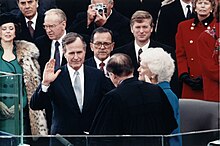
The First Congress explicitly prescribed the phrase "So help me God" in oaths nether the Judiciary Act of 1789 for all U.Southward. judges and officers other than the president. It was prescribed even before under the various commencement land constitutions[27] besides as past the Second Continental Congress in 1776.[28] [29] Although the phrase is mandatory in these oaths, the said Act as well allows for the selection that the phrase be omitted past the officer, in which case it would be chosen an affirmation instead of an oath: "Which words, then help me God, shall be omitted in all cases where an affirmation is admitted instead of an oath."[30] In dissimilarity, the adjuration of the president is the only oath specified in the Constitution. Information technology does non include the closing phrase "So assist me God," and it also allows for the optional form of an affirmation which is not considered an oath. In practice, however, most presidents, at least during the last century, have opted to take the oath (rather than an affirmation), to use a Bible to do so, and as well to close the adjuration with the customary phrase.
At that place is currently debate as to whether or not George Washington, the offset president, added the phrase to his credence of the oath.[31] The earliest known source indicating Washington added "And then help me God" to his acceptance, not to the oath, is attributed to Washington Irving, aged vi at the time of the inauguration, and outset appears 65 years later the event.[32] The simply contemporary account that repeats the oath in full, a report from the French consul, Comte de Moustier, states but the constitutional adjuration,[33] without reference to Washington'due south adding "So aid me God" to his acceptance.
The historical argue over who first used "So help me God" is marred by ignoring the ii forms of giving the oath. The first, now in decay, is when the administrator articulates the constitutional oath in the form of a question, as in, "Do yous George Washington solemnly swear ...", requesting an affirmation. At that betoken a response of "I do" or "I swear" completes the oath. Without verbatim transcripts, the scant existing testify shows this was the mutual process at least until the early on 20th century. In 1865 the Sacramento Daily Marriage covered the 2nd inauguration of Abraham Lincoln. Lincoln finished his adjuration with "So aid me God," and he kissed the Bible.[34] Yet, the Daily Union's account seems embellished in a number of means, and other paper accounts, published closer in fourth dimension to the ceremony, exercise not mention Lincoln'southward uttering the phrase.[35] In 1881, the New York Times commodity covering the swearing in of Chester A. Arthur reported that he responded to the question of accepting the oath with the words, "I volition, and then help me God."[14] In 1929, Fourth dimension magazine reported that the master justice began the adjuration uttering, "You, Herbert Hoover, practice you solemnly swear ..."[fifteen] Hoover replied with a unproblematic "I do."
A contemporaneous newspaper account of Lincoln's 1865 inauguration states that Lincoln appended the phrase "So help me God" to the oath.[34] This newspaper report is followed past another account, provided after in the same twelvemonth afterward Lincoln's decease (Apr 15, 1865), that Lincoln said "So assist me God" during his oath.[36] The evidence pertaining to the 1865 inauguration is much stronger than that pertaining to Lincoln'south 1861 utilise of the phrase. Several sources merits that Lincoln said "So help me God" at his 1861 inauguration, all the same these sources were not contemporaneous to the event.[37] [38] During the speech communication, Lincoln stated that his oath was "registered in Sky,"[39] something some have taken every bit indicating he likely uttered the phrase "So help me God." Conversely, at that place was a claim made by A. Thou. Milligan (a Presbyterian government minister who advocated for an official Christian U.S. authorities) that letters were sent to Abraham Lincoln asking him to swear to God during his inaugurations, and Lincoln allegedly wrote back proverb that God'due south name was not in the Constitution, and he could non depart from the letter of that instrument.[forty] [ full citation needed ] [41]
All federal judges and executive officers were required as early as 1789 by statute to include the phrase unless they affirmed, in which instance the phrase must exist omitted.[42] Given that nearly every president-elect since President Franklin D. Roosevelt has recited the additional phrase, information technology is likely that the bulk of presidents-elect have uttered it.[43]
Oath mishaps [edit]

Barack Obama existence administered the oath of office by Chief Justice John Roberts for the 2d fourth dimension, on January 21, 2009.
- In 1909, when President William Howard Taft was sworn in, Chief Justice Melville Fuller misquoted the oath, only the error was not publicized at the time. The mistake was like to the one Taft himself would brand twenty years later when swearing in President Hoover. Recalling the incident, Taft wrote, "When I was sworn in as president by Chief Justice Fuller, he made a similar slip," and added, "just in those days when there was no radio, information technology was observed merely in the Senate chamber where I took the oath."[15]
- In 1929, Chief Justice Taft, himself formerly a president of the United states of america, garbled the adjuration when he swore in President Herbert Hoover using the words "preserve, maintain, and defend the Constitution," instead of "preserve, protect, and defend." The fault was picked upwardly past schoolgirl Helen Terwilliger on the radio. Taft somewhen acknowledged his error, but did not think information technology was important, and Hoover did non retake the adjuration. In Taft's view, his departure from the text did not invalidate the oath.[15] [44] [45]
- In 1945, President Harry S. Truman's blank initial caused an unusual slip when he first became president and took the oath. At a coming together in the Cabinet Room, Master Justice Harlan Stone, plainly mistaken about the meaning of Truman's eye initial (which is not an abbreviation but rather the whole middle name in itself), began reading the oath past saying "I, Harry Shipp Truman, ..." Truman responded: "I, Harry Due south Truman, ..."[46]
- In both his 1953 and 1957 inaugurations, Dwight D. Eisenhower read the line "the part of President of the United States" equally "the part of the President of the United States," even as principal justices Fred Vinson (in 1953) and Earl Warren (in 1957) said the line correctly.
- In 1965, Main Justice Earl Warren prompted Lyndon Johnson to say, "the Office of the Presidency of the Usa."[47]
- In 1973, President Richard Nixon added the word "and" between "preserve" and "protect," resulting in "preserve and protect, and defend the Constitution of the U.s.a.." Nixon had recited the line correctly during his first inauguration.
- In 2009, Chief Justice John Roberts, while administering the oath to Barack Obama, incorrectly recited part of the oath. Roberts prompted, "That I will execute the Part of President to the Usa faithfully." Obama stopped at "execute," and waited for Roberts to correct himself. Roberts, after a simulated starting time, then followed Obama's "execute" with "faithfully," which results in "execute faithfully," which is too wrong. Obama then repeated Roberts' initial, incorrect prompt, with the word "faithfully" after "Usa."[48] [49] The oath was re-administered the next 24-hour interval by Roberts at the White Firm.[l] [51]
Listing of swearing-in events [edit]
Since the office of President of the Us came into existence in 1789 there have been 59 public swearing-in ceremonies to mark the commencement of a new four-year presidential term, plus an additional nine marking the showtime of a fractional presidential term following the intra-term decease or resignation of an incumbent president. With the 2021 inauguration of Joe Biden, the presidential oath has been taken 76 different times past 45 persons. This numerical discrepancy results chiefly from two factors: a president must take the oath at the first of each term of function, and, considering Inauguration Day has sometimes fallen on a Sunday, five presidents accept taken the oath privately before the public inauguration ceremony. In improver, three have repeated the oath as a precaution against potential later constitutional challenges.[52]
| Engagement | Type | Event[a] | Location | Oath administered by |
|---|---|---|---|---|
| Apr xxx, 1789 (Th) | Public | Offset inauguration of George Washington | Balustrade, Federal Hall New York, New York | Robert Livingston Chancellor of New York |
| March 4, 1793 (Monday) | Public | Second inauguration of George Washington | Senate Chamber, Congress Hall Philadelphia, Pennsylvania | William Cushing Acquaintance Justice, U.South. Supreme Courtroom |
| March 4, 1797 (Saturday) | Public | Inauguration of John Adams | Firm Chamber, Congress Hall | Oliver Ellsworth Main Justice of the United States |
| March 4, 1801 (Wednesday) | Public | First inauguration of Thomas Jefferson | Senate Bedroom, U.S. Capitol Washington, D.C. | John Marshall Chief Justice of the United states of america |
| March 4, 1805 (Monday) | Public | Second inauguration of Thomas Jefferson | Senate Chamber, U.S. Capitol | John Marshall Master Justice |
| March four, 1809 (Saturday) | Public | Outset inauguration of James Madison | Firm Sleeping room, U.S. Capitol | John Marshall Chief Justice |
| March 4, 1813 (Thursday) | Public | 2d inauguration of James Madison | House Chamber, U.S. Capitol | John Marshall Chief Justice |
| March 4, 1817 (Tuesday) | Public | First inauguration of James Monroe | Front steps, Old Brick Capitol | John Marshall Chief Justice |
| March 5, 1821 [b] (Monday) | Public | Second inauguration of James Monroe | House Bedchamber, U.Due south. Capitol | John Marshall Primary Justice |
| March four, 1825 (Fri) | Public | Inauguration of John Quincy Adams | Business firm Chamber, U.S. Capitol | John Marshall Chief Justice |
| March 4, 1829 (Wednesday) | Public | First inauguration of Andrew Jackson | Due east Portico, U.S. Capitol | John Marshall Primary Justice |
| March 4, 1833 (Monday) | Public | Second inauguration of Andrew Jackson | House Chamber, U.S. Capitol | John Marshall Principal Justice |
| March 4, 1837 (Sabbatum) | Public | Inauguration of Martin Van Buren | East Portico, U.S. Capitol | Roger B. Taney Chief Justice of the The states |
| March iv, 1841 (Thursday) | Public | Inauguration of William Henry Harrison | East Portico, U.S. Capitol | Roger B. Taney Chief Justice |
| Apr 6, 1841 [c] (Tuesday) | Private | Inauguration of John Tyler | Chocolate-brown'south Indian Queen Hotel, Washington, D.C. | William Cranch Principal Judge, U.Southward. Circuit Court of the Commune of Columbia |
| March four, 1845 (Tuesday) | Public | Inauguration of James K. Polk | Eastward Portico, U.Due south. Capitol | Roger B. Taney Main Justice |
| March 5, 1849 [b] (Monday) | Public | Inauguration of Zachary Taylor | East Portico, U.Southward. Capitol | Roger B. Taney Master Justice |
| July 10, 1850 [d] (Wednesday) | Public | Inauguration of Millard Fillmore | House Chamber, U.S. Capitol | William Cranch Circuit Courtroom Estimate |
| March 4, 1853 (Friday) | Public | Inauguration of Franklin Pierce | East Portico, U.S. Capitol | Roger B. Taney Principal Justice |
| March 4, 1857 (Wednesday) | Public | Inauguration of James Buchanan | East Portico, U.S. Capitol | Roger B. Taney Chief Justice |
| March 4, 1861 (Monday) | Public | First inauguration of Abraham Lincoln | Eastward Portico, U.S. Capitol | Roger B. Taney Chief Justice |
| March 4, 1865 (Sat) | Public | 2nd inauguration of Abraham Lincoln | East Portico, U.South. Capitol | Salmon P. Chase Chief Justice of the United States |
| April 15, 1865 (Saturday) | Individual | Inauguration of Andrew Johnson | Kirkwood House Hotel, Washington, D.C. | Salmon P. Chase Primary Justice |
| March 4, 1869 (Thursday) | Public | Outset inauguration of Ulysses Due south. Grant | Due east Portico, U.S. Capitol | Salmon P. Chase Principal Justice |
| March 4, 1873 (Tuesday) | Public | Second inauguration of Ulysses S. Grant | East Portico, U.S. Capitol | Salmon P. Chase Chief Justice |
| March 3, 1877 [53] [b] (Saturday) | Private | Inauguration of Rutherford B. Hayes | Ruddy Room, White House | Morrison Waite Main Justice of the U.s.a. |
| March five, 1877 [b] (Mon) | Public | East Portico, U.S. Capitol | ||
| March four, 1881 (Friday) | Public | Inauguration of James A. Garfield | East Portico, U.S. Capitol | Morrison Waite Main Justice |
| September 20, 1881 [54] [due east] (Tuesday) | Private | Inauguration of Chester A. Arthur | Chester A. Arthur Dwelling, New York, New York | John R. Brady Justice of the New York Supreme Courtroom |
| September 22, 1881 [due east] (Th) | Public | The Vice President'south Room, U.S. Capitol | Morrison Waite Primary Justice | |
| March 4, 1885 (Wed) | Public | Commencement inauguration of Grover Cleveland | East Portico, U.S. Capitol | Morrison Waite Chief Justice |
| March iv, 1889 (Monday) | Public | Inauguration of Benjamin Harrison | East Portico, U.Due south. Capitol | Melville Fuller Primary Justice of the United States |
| March 4, 1893 (Saturday) | Public | Second inauguration of Grover Cleveland | East Portico, U.Due south. Capitol | Melville Fuller Master Justice |
| March 4, 1897 (Thursday) | Public | Starting time inauguration of William McKinley | Front of original Senate Wing U.S. Capitol | Melville Fuller Chief Justice |
| March 4, 1901 (Monday) | Public | 2nd inauguration of William McKinley | East Portico, U.S. Capitol | Melville Fuller Master Justice |
| September 14, 1901 (Saturday) | Private | First inauguration of Theodore Roosevelt | Ansley Wilcox Dwelling house, Buffalo, New York | John R. Hazel Judge, U.S. District Court for the Western District of New York |
| March 4, 1905 (Saturday) | Public | 2d inauguration of Theodore Roosevelt | East Portico, U.South. Capitol | Melville Fuller Chief Justice |
| March 4, 1909 (Thursday) | Public | Inauguration of William Howard Taft | Senate Chamber, U.Southward. Capitol | Melville Fuller Chief Justice |
| March 4, 1913 (Tuesday) | Public | First inauguration of Woodrow Wilson | East Portico, U.S. Capitol | Edward D. White Chief Justice of the United States |
| March four, 1917 [55] (Sunday) | Private | Second inauguration of Woodrow Wilson | The President's Room, U.S. Capitol | Edward D. White Principal Justice |
| March 5, 1917 [b] (Monday) | Public | E Portico, U.S. Capitol | ||
| March four, 1921 (Friday) | Public | Inauguration of Warren One thousand. Harding | East Portico, U.Due south. Capitol | Edward D. White Primary Justice |
| August three, 1923 [56] [f] (Friday) | Private | First inauguration of Calvin Coolidge | Coolidge Homestead, Plymouth Notch, Vermont | John Calvin Coolidge Vermont justice of the peace |
| August 21, 1923 [56] [f] (Tuesday) | Private | Willard Hotel Washington, D.C. | Adolph A. Hoehling Jr. Judge, U.South. District Court for the District of Columbia | |
| March four, 1925 (Wednesday) | Public | Second inauguration of Calvin Coolidge | East Portico, U.S. Capitol | William H. Taft Principal Justice of the United States |
| March 4, 1929 (Monday) | Public | Inauguration of Herbert Hoover | East Portico, U.S. Capitol | William H. Taft Chief Justice |
| March 4, 1933 (Saturday) | Public | Offset inauguration of Franklin D. Roosevelt | East Portico, U.South. Capitol | Charles East. Hughes Principal Justice of the U.s.a. |
| Jan 20, 1937 (Wednesday) | Public | Second inauguration of Franklin D. Roosevelt | East Portico, U.S. Capitol | Charles E. Hughes Chief Justice |
| January 20, 1941 (Monday) | Public | Tertiary inauguration of Franklin D. Roosevelt | East Portico, U.S. Capitol | Charles E. Hughes Primary Justice |
| January 20, 1945 (Sabbatum) | Public | Fourth inauguration of Franklin D. Roosevelt | Due south Portico, White House | Harlan F. Stone Chief Justice of the United States |
| April 12, 1945 (Thursday) | Individual | Outset inauguration of Harry S. Truman | Cabinet Room, White House | Harlan F. Stone Chief Justice |
| January 20, 1949 (Th) | Public | Second inauguration of Harry South. Truman | Due east Portico, U.Southward. Capitol | Fred Chiliad. Vinson Main Justice of the United States |
| January xx, 1953 (Tuesday) | Public | First inauguration of Dwight D. Eisenhower | East Portico, U.South. Capitol | Fred Thousand. Vinson Chief Justice |
| January 20, 1957 (Lord's day) | Private | Second inauguration of Dwight D. Eisenhower | Eastward Room, White Business firm | Earl Warren Main Justice of the United states |
| January 21, 1957 [thousand] (Mon) | Public | E Portico, U.S. Capitol | ||
| January 20, 1961 (Friday) | Public | Inauguration of John F. Kennedy | East Portico, U.Due south. Capitol | Earl Warren Main Justice |
| November 22, 1963 (Friday) | Private | First inauguration of Lyndon B. Johnson | Air Force I, Dallas Love Field, Dallas, Texas | Sarah T. Hughes Judge, U.South. District Court for the Northern Commune of Texas |
| January 20, 1965 (Wednesday) | Public | Second inauguration of Lyndon B. Johnson | East Portico, U.S. Capitol | Earl Warren Chief Justice |
| Jan 20, 1969 (Mon) | Public | Get-go inauguration of Richard Nixon | East Portico, U.Southward. Capitol | Earl Warren Chief Justice |
| January twenty, 1973 (Saturday) | Public | Second inauguration of Richard Nixon | Due east Portico, U.S. Capitol | Warren Burger Chief Justice of the United States |
| August 9, 1974 (Friday) | Public | Inauguration of Gerald Ford | East Room, White House | Warren Burger Chief Justice |
| January 20, 1977 (Th) | Public | Inauguration of Jimmy Carter | E Portico, U.S. Capitol | Warren Burger Chief Justice |
| Jan 20, 1981 (Tuesday) | Public | First inauguration of Ronald Reagan | West Front, U.Due south. Capitol | Warren Burger Chief Justice |
| January xx, 1985 (Lord's day) | Private | Second inauguration of Ronald Reagan | Entrance Hall, White House | Warren Burger Primary Justice |
| January 21, 1985 [g] (Monday) | Public | Rotunda, U.Southward. Capitol | ||
| January 20, 1989 (Fri) | Public | Inauguration of George H. W. Bush | West Front, U.Due south. Capitol | William Rehnquist Chief Justice of the United states of america |
| Jan 20, 1993 (Wednesday) | Public | First inauguration of Pecker Clinton | Westward Front, U.South. Capitol | William Rehnquist Chief Justice |
| January 20, 1997 (Monday) | Public | Second inauguration of Beak Clinton | Westward Forepart, U.S. Capitol | William Rehnquist Primary Justice |
| January xx, 2001 (Saturday) | Public | Start inauguration of George West. Bush-league | West Front, U.Due south. Capitol | William Rehnquist Primary Justice |
| January twenty, 2005 (Th) | Public | Second inauguration of George Due west. Bush | West Front, U.S. Capitol | William Rehnquist Primary Justice |
| January 20, 2009 (Tuesday) | Public | Kickoff inauguration of Barack Obama | West Forepart, U.Southward. Capitol | John Roberts Chief Justice of the U.s. |
| January 21, 2009 [57] [h] (Midweek) | Private | Map Room, White House | ||
| Jan xx, 2013 [58] (Sunday) | Private | 2d inauguration of Barack Obama | Blueish Room, White House | John Roberts Chief Justice |
| January 21, 2013 [g] (Monday) | Public | West Forepart, U.S. Capitol | ||
| January 20, 2017 (Fri) | Public | Inauguration of Donald Trump | West Front, U.S. Capitol | John Roberts Chief Justice |
| Jan 20, 2021 (Wednesday) | Public | Inauguration of Joe Biden | W Front end, U.S. Capitol | John Roberts Chief Justice |
| ZZZDate | ZZZType | ZZZEvent | ZZZLocation | ZZZAdjuration administered by |
Notes [edit]
- ^ Inaugurations sort alphabetically past president'due south terminal name.
- ^ a b c d e Term began Sunday, March four.
- ^ Term began when President Harrison died on April 4.
- ^ Term began when President Taylor died on July 9.
- ^ a b Term began when President Garfield died on September 19.
- ^ a b Term began when President Harding died on August 2.
- ^ a b c Term began Sunday, January xx.
- ^ Adjuration repeated later "mishap" at the public ceremony.

Map showing locations where the oath of office was get-go taken, marked with a green 'O' (or a dark-green dot for scheduled occurrences). Locations where presidencies ended unexpectedly are marked with a cerise 'X' (a cherry dot denoted scheduled transitions). The nine sets of names shown in black denote the location where presidencies take ended intra-term due to the incumbent's death (four presidents have died of natural causes and four were assassinated—names underlined in grey) or resignation (one, noted past a superscript 'R'). The inset at the lesser of the map is Adjuration or Affirmation Clause (Commodity II, Department One, Clause 8) of the U.Southward. Constitution.
See too [edit]
- Presidential Succession Act
- Adjuration of part of the vice president of the United States
References [edit]
- ^ Kesavan, Vasan. "Essays on Article Two: Oath of Office". The Heritage Foundation. Retrieved July 20, 2016.
- ^ "The Constitution of the U.s.a. of America: Analysis and Interpretation, Centennial Edition, Acting Edition: Assay of Cases Decided past the Supreme Court of the United States to June 26, 2013" (PDF). Washington, DC: U.South. Government Printing Role. 2013. p. 13.
- ^ Larson, Edward J.; Shesol, Jeff. "Twentieth Amendment". Interactive Constitution. Philadelphia, Pennsylvania: National Constitution Center. Retrieved Baronial i, 2019.
- ^ Arbelbide, C. L. (Winter 2000). "Precipitous Transition". Prologue. Vol. 32, no. 4. Washington, D.C.: National Archives. Retrieved August 1, 2019.
- ^ "Presidential Ballot of 1789". George Washington'due south Mount Vernon. Mount Vernon Ladies' Clan. Retrieved Oct 21, 2015.
- ^ "George Washington's Inaugural Accost". The National Athenaeum. Retrieved Oct 4, 2015.
- ^ "President Millard Fillmore, 1850". Joint Congressional Committee on Inaugural Ceremonies. Retrieved 2009-01-23 .
- ^ Glenn D. Kittler, Hail to the Chief!: The Inauguration Days of our Presidents, 1965, page 167.
- ^ Porter H. Dale, "The Calvin Coolidge Inauguration Revisited: An Eyewitness Account by Congressman Porter H. Dale", Vermont History, 1994, Volume 62, pp. 214–222.
- ^ "Adjuration Of Office: To Swear Or To Affirm". NPR.org. January 18, 2009.
- ^ Bendat, Jim (2012). Democracy's Large Twenty-four hour period: The Inauguration of Our President, 1789–2013. iUniverse. pp. xi, 28, 36. ISBN978-1-935278-47-four.
- ^ Consume, Wendy (July 1, 2016). "Quaker Presidents and the Adjuration of Role". renofriends.org. Reno Friends Quaker Meeting. Retrieved December 22, 2021.
- ^ YouTube. Archived from the original on 2021-12-22.
- ^ a b "The New Administration; President Arthur Formally Inaugurated". The New York Times. September 23, 1881.
- ^ a b c d Time Mag, Mar. 25, 1929]. Retrieved 2009-01-23. [ dead link ]
- ^ Herbert Hoover Takes the Oath of Function. February 6, 2009. Archived from the original on 2021-12-22 – via YouTube.
- ^ Franklin D. Roosevelt – Adjuration of function March quaternary, 1933. June nineteen, 2007. Archived from the original on 2021-12-22 – via YouTube.
- ^ Harry S. Truman – Oath of office January 20th, 1949. June 19, 2007. Archived from the original on 2021-12-22 – via YouTube.
- ^ http://www.stjohns1.org/portal/gwib "St. John's Lodge No. 1, Ancient York Masons".
- ^ Articulation Congressional Committee on Inauguration Ceremonies website: "Inauguration of President George Washington, 1789". Retrieved 2009-02-16.
- ^ McCullough, David (1992). Truman. New York: Simon and Schuster. pp. 347, 729. ISBN0-671-86920-five. Harry Truman is a notable instance, as he aptitude and kissed the Bible upon taking the adjuration for the beginning time, on April 12, 1945, as well every bit at his second inauguration.
- ^ "Inaugural fun facts". Toledo, OH: WTOL.com. Retrieved 2010-08-07 .
- ^ a b "Bibles Used in Inaugural Ceremonies". Archived from the original on September 25, 2015. Retrieved March 24, 2015.
{{cite web}}: CS1 maint: bot: original URL status unknown (link) - ^ Kennon, Donald (2005). "Presidential Inaugurations By and Present". Retrieved 2006-12-06 .
- ^ Glass, Andrew J. (February 26, 1967). "Catholic Church building Missal, Non Bible, Used by Johnson for Oath at Dallas" (PDF). The Washington Postal service . Retrieved June fifteen, 2014.
- ^ Schumaker, Erin (January xx, 2021). "The significance of the Bible Joe Biden is using on Inauguration Twenty-four hour period". abcnews.get.com. ABC News Network. Retrieved January 21, 2021.
- ^ "Georgia Constitution of 1777". GeorgiaInfo. University of Georgia Libraries. Archived from the original on 2012-11-14. Retrieved 2012-11-28 .
- ^ "Intelligence in the War of Independence". Central Intelligence Agency. Archived from the original on December x, 2008. Retrieved Dec 26, 2008.
- ^ "Oaths of Enlistment and Oaths of Office". U.Southward. Army Middle of Military History. Retrieved 31 March 2018.
- ^ Judiciary Act of 1789, Sec. seven. Retrieved 2009-01-24.
- ^ Peter R. Henriques, "'So Help Me God': A George Washington Myth that Should Exist Discarded". History Bytes News Network (January 12, 2009).
- ^ Griswold, Rufus W. (1855) [1854]. The Republican court, or, American society in the days of Washington. New York: D. Appleton and Company. pp. 141–142.
- ^ Documentary History of the First Federal Congress, Vol. 15, pp. 404–405.
- ^ a b "Messages from Washington: Inauguration Day". Sacramento Daily Union. April 10, 1865. p. eight. Retrieved December 18, 2018 – via California Digital Newspaper Collection.
- ^ "The New York herald. [book], March 05, 1865, Epitome i". New York Herald. 5 March 1865. Retrieved September 25, 2019 – via Library of Congress, Chronicling America.
- ^ Benjamin Franklin Morris, ed. (1865). Memorial tape of the nation's tribute to Abraham Lincoln. Due west. H. & O. H. Morrison. Retrieved 2010-08-07 .
- ^ Chittenden, Lucius Eugene (1904). Recollections of President Lincoln and his Administration. Harper & Brothers. Retrieved 2010-08-07 .
- ^ Peter Selby (1900). Anecdotal Lincoln. Thompson & Thomas. Retrieved 2010-08-07 .
- ^ "First Inaugural Address of Abraham Lincoln". The Avalon Project. Lillian Goldman Law Library, Yale University.
- ^ Foster, James Mitchell (1894) [1894]. Christ the King. Boston: James H. Earle. p. 277. In fact, Milligan did write to Lincoln, just his asking was non that Lincoln add "so assistance me God" to the Oath, merely rather that the name of Jesus Christ exist added to the U.S. Constitution. [1]
- ^ Foster, James Mitchell (1890). Reformation Principles Stated and Practical. Chicago and New York: F. H. Revell. pp. 234–235.
- ^ "A Century of Code for a New Nation: U.S. Congressional Documents and Debates, 1774–1875".
- ^ "Inauguration of the President: Facts & Firsts". U.S. Senate. Retrieved December thirteen, 2008.
- ^ Agence France-Presse (2009-01-21). "Master justice leads Obama to stumble presidential oath". ABS-CBN News. Retrieved 2010-08-07 .
- ^ "No Problems With Today's Adjuration at the Supreme Courtroom – The BLT: The Blog of Legal Times". Legaltimes.typepad.com. 2009-01-21. Retrieved 2010-08-07 .
- ^ McCullough, p. 347.
- ^ "Lyndon B. Johnson Oath of Role, January 20, 1965". Retrieved 2009-02-01 .
- ^ Williams, Pete (January 20, 2009). "About That Adjuration Flub". MSNBC. Archived from the original on Jan 21, 2009. Retrieved January 21, 2009.
- ^ File:Barack Obama Adjuration of Office.ogg
- ^ "Obama retakes oath of office after Roberts' error". CNN. January 21, 2013. Retrieved January 21, 2009.
- ^ Obama is Sworn in for 2d Time, BBC News. Retrieved January 22, 2009.
- ^ "Inauguration at the U.S. Capitol". Architect of the Capitol. Retrieved Jan 22, 2017.
- ^ "Spiegel Grove: Rutherford B. Hayes Presidential Center". National Park Service, U.South. Section of the Interior. Retrieved February 5, 2017.
- ^ "Chester A. Arthur House". National Park Service, U.Southward. Department of the Interior. Retrieved Feb v, 2017.
- ^ "Wilson to Take Oath Lord's day: Showtime Swearing Into Office on March iv Volition Be Repeated the Following Day". The New York Times. November 15, 1916. Retrieved February 5, 2017.
- ^ a b Arbelbide, C. L. (Winter 2000). "Abrupt Transition". Prologue. Vol. 32, no. 4. The National Archives. Retrieved February 5, 2017.
- ^ "Obama retakes oath of function after Roberts' error". CNN. January 21, 2009. Retrieved January 21, 2009.
- ^ "Obama to take individual oath in brief family service".
External links [edit]
- Forrest Church, Ph.D., "Did George Washington Say 'So Assistance Me God'?"
- Video on YouTube Video of inaugurations from Franklin D. Roosevelt – Barack H. Obama
Source: https://en.wikipedia.org/wiki/Oath_of_office_of_the_president_of_the_United_States

Post a Comment for "Oath of Words Only Once Again"